 Add to Chrome
 Add to Firefox
 Add to Edge
LingLanMiDian: Systematic Evaluation of LLMs on TCM Knowledge and Clinical Reasoning
Feb 02, 2026
Large language models (LLMs) are advancing rapidly in medical NLP, yet Traditional Chinese Medicine (TCM) with its distinctive ontology, terminology, and reasoning patterns requires domain-faithful evaluation. Existing TCM benchmarks are fragmented in coverage and scale and rely on non-unified or generation-heavy scoring that hinders fair comparison. We present the LingLanMiDian (LingLan) benchmark, a large-scale, expert-curated, multi-task suite that unifies evaluation across knowledge recall, multi-hop reasoning, information extraction, and real-world clinical decision-making. LingLan introduces a consistent metric design, a synonym-tolerant protocol for clinical labels, a per-dataset 400-item Hard subset, and a reframing of diagnosis and treatment recommendation into single-choice decision recognition. We conduct comprehensive, zero-shot evaluations on 14 leading open-source and proprietary LLMs, providing a unified perspective on their strengths and limitations in TCM commonsense knowledge understanding, reasoning, and clinical decision support; critically, the evaluation on Hard subset reveals a substantial gap between current models and human experts in TCM-specialized reasoning. By bridging fundamental knowledge and applied reasoning through standardized evaluation, LingLan establishes a unified, quantitative, and extensible foundation for advancing TCM LLMs and domain-specific medical AI research. All evaluation data and code are available at https://github.com/TCMAI-BJTU/LingLan and http://tcmnlp.com.

On the Interplay of Human-AI Alignment,Fairness, and Performance Trade-offs in Medical Imaging
May 15, 2025Deep neural networks excel in medical imaging but remain prone to biases, leading to fairness gaps across demographic groups. We provide the first systematic exploration of Human-AI alignment and fairness in this domain. Our results show that incorporating human insights consistently reduces fairness gaps and enhances out-of-domain generalization, though excessive alignment can introduce performance trade-offs, emphasizing the need for calibrated strategies. These findings highlight Human-AI alignment as a promising approach for developing fair, robust, and generalizable medical AI systems, striking a balance between expert guidance and automated efficiency. Our code is available at https://github.com/Roypic/Aligner.
Knowledge Graph Completion based on Tensor Decomposition for Disease Gene Prediction
Feb 18, 2023
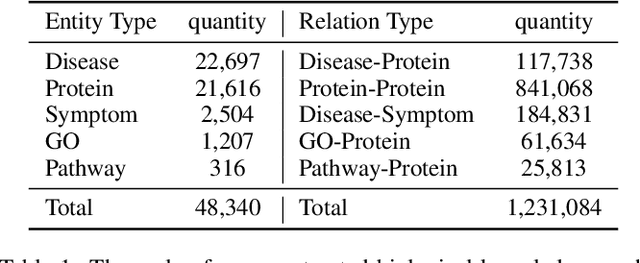

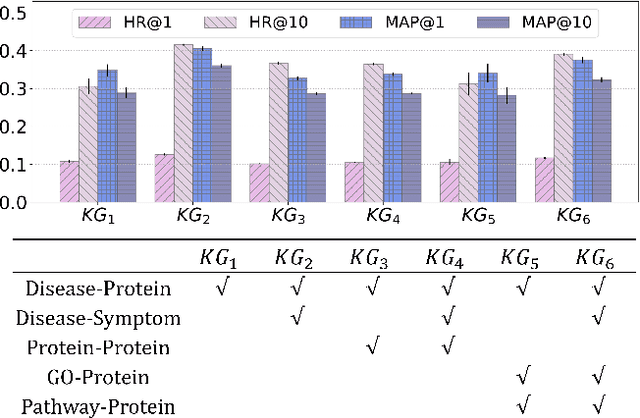
Accurate identification of disease genes has consistently been one of the keys to decoding a disease's molecular mechanism. Most current approaches focus on constructing biological networks and utilizing machine learning, especially, deep learning to identify disease genes, but ignore the complex relations between entities in the biological knowledge graph. In this paper, we construct a biological knowledge graph centered on diseases and genes, and develop an end-to-end Knowledge graph completion model for Disease Gene Prediction using interactional tensor decomposition (called KDGene). KDGene introduces an interaction module between the embeddings of entities and relations to tensor decomposition, which can effectively enhance the information interaction in biological knowledge. Experimental results show that KDGene significantly outperforms state-of-the-art algorithms. Furthermore, the comprehensive biological analysis of the case of diabetes mellitus confirms KDGene's ability for identifying new and accurate candidate genes. This work proposes a scalable knowledge graph completion framework to identify disease candidate genes, from which the results are promising to provide valuable references for further wet experiments.